


What Is a Dakimakura? A Beginner's Guide to Anime Body Pillow Covers

A dakimakura (抱き枕) is a Japanese hugging pillow. In the anime hobby, the word usually means the cover: a long fabric shell printed with character art, often on both sides, that zips over a separate inner pillow. The art, the fabric, and the artist credit are all on the cover, so that's what collectors shop for.
Most people don't know the word yet when they start. They search "anime body pillow," and the results mix real artist releases with covers printed from stolen art or AI images. In a listing photo the two can look identical. Most of this guide is about telling them apart and getting the size and fabric right the first time.
We're Heart Club, a small doujin circle that commissions human artists for our covers and prints them on 2-Way Tricot. This guide is what we wish every first-time buyer knew before clicking the first Google result, especially how to avoid the bootleg trap that catches so many new collectors.
What "dakimakura" means
Dakimakura is Japanese for "hugging pillow": daki means to hold or embrace, and makura means pillow. In the anime hobby, it usually means a long pillow cover printed with character art, often front and back, made for a matching inner pillow. A complete dakimakura has two parts:
- The cover: the printed fabric shell with the artwork.
- The inner: the long pillow insert that gives the cover its shape.
Collectors mostly talk about covers, since that's where the art, credit, fabric, print quality, and release history are. The inner still matters, though. A weak inner can make a beautiful cover sag, wrinkle, or distort.
Most modern collector covers are 160 × 50cm. Older official/licensed covers and some Japanese releases use 150 × 50cm, and there's an oversized 180 × 60cm format that needs its own inner.
You'll also see "anime body pillow cover," "hugging pillow cover," "daki," or just "cover." Collectors say dakimakura. Search engines and most first-time buyers say anime body pillow cover. Both mean the same product.
Dakimakura cover vs inner pillow
Most dakimakura listings are for the cover only. The inner is a separate purchase.
This surprises a lot of new buyers: the package arrives and it's a folded piece of fabric instead of a pillow. That's normal. Inners are bulky and expensive to ship, and serious collectors usually want to choose their own fill and firmness anyway.
| Part | What it does | What to check |
|---|---|---|
| Cover | Holds the character artwork and touches your skin | Size, fabric, artist credit, print quality, front/back design |
| Inner pillow | Gives the cover shape, support, and loft | Matching size, fill weight, firmness, shell quality |
Match the sizes. A 160 × 50cm cover goes on a 160 × 50cm inner. A 150 × 50cm cover will often fit a 160 × 50cm inner too, as long as the cover is stretchy 2-Way Tricot and the inner isn't overfilled. Some people take out a little stuffing to make it work. If the zipper fights you, stop, because forcing it strains the zipper and seams, and enough pressure can tear the stitching. In the other direction, a cover on an inner that's too small just droops and bunches up.
If you're starting from nothing, get a 160 × 50cm inner. Most current covers are made for it, and a 150cm inner starts to feel limiting as soon as your next cover is 160cm.
Heart Club sells covers only, so you'll need an inner from somewhere else. Our dakimakura inner pillow guide goes through sizing, fill, firmness, and specific inners worth knowing about.
How to buy one without getting burned
The dakimakura hobby has a real bootleg problem, and new buyers are the ones it usually catches. Unfortunately, the easiest Google result is often the worst place to start.
Large storefronts scrape art from artists and circles, strip the credit, print it on poor fabric, and sell it as official or original. Their product photos often look fine because they were taken from the real release. The difference shows up when the cover arrives: dull colors, blurry lines, weak fabric, bad stitching. None of the money goes to the artist.
No single check below proves anything, but a listing that fails several of these criteria is one to skip.
- Artist credit: Can you find the illustrator? Do they have a real portfolio or social account?
- Release trail: Does the listing connect to a circle, artist, event, preorder, or official product page?
- Fabric: Is it premium 2WT, or a suspicious menu of low-end fabric options?
- Catalog size: Does the shop carry hundreds or thousands of unrelated designs with no coherent artist credits?
- Price: Is the cover suspiciously cheap compared to normal cover pricing?
- Image quality: Are previews watermarked, strangely cropped, or inconsistent across products?
- Terms: Does the shop explain who made the art and what rights they have to sell it?
A legitimate cover usually has some sort of provenance: a doujin circle, an official licensed release, an artist's BOOTH page, a reputable community brand, or a shop that commissions and credits artists. To check a seller, Dakidex's Stores & Circles list is a good place to start. It doesn't cover every shop, but it can point out known legitimate sellers and known bootleggers before you spend money. You can also ask experienced collectors in the Dakimakuras Discord community if a listing feels off. And if a store can't tell you who drew the art, move on.
There is also a bigger reason to care. Dakimakura is a niche hobby, and money spent at bootleg shops never reaches the artists, circles, and small sellers making new covers. If enough of it drains away, everyone ends up with fewer original releases, more stolen art, more AI slop, and more storefronts treating the whole category like disposable content.
It's also why we're strict about artist credit and no-AI production at Heart Club. We commission real illustrators, match them to the character, and keep the work human from sketch to final file. For the longer version, check out our post on why we commission human artists and say no to AI art.
Common dakimakura sizes
If you remember one number, make it 160 × 50cm. It's the modern collector standard and the size Heart Club uses for our main covers. Quality inners are easiest to find in it, most doujin circles print it, and you'll run into fewer weird fit problems. Even if your first cover is 150 × 50cm, a good 160 × 50cm inner is usually the more future-proof buy, as long as you watch the fill and don't force the zipper.
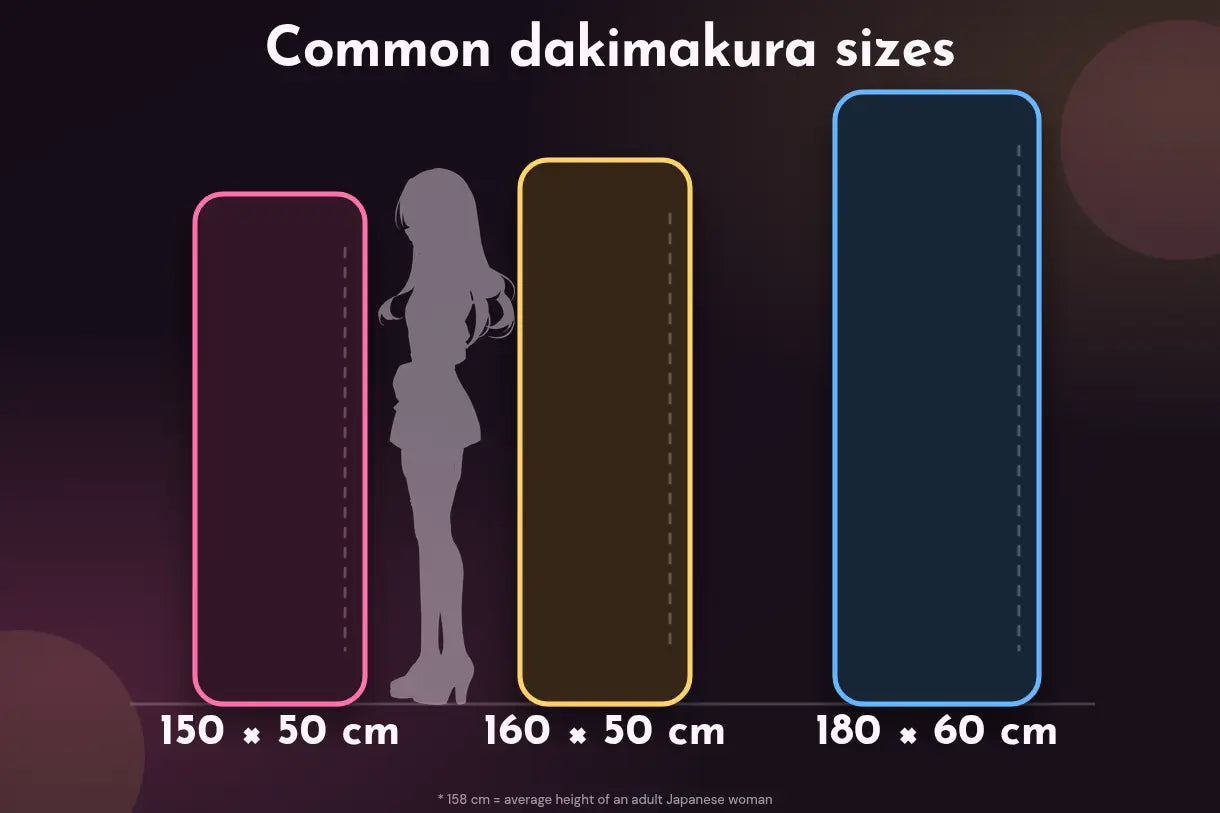
| Size | Where you see it | Beginner note |
|---|---|---|
| 150 × 50cm | Older releases, some official/licensed Japanese goods, some low-end shops | Not automatically fake, but do not rush into a 150cm inner unless you know you will stay with that size |
| 160 × 50cm | Modern doujin and premium covers | Best default for a first setup |
| 180 × 60cm | Oversized customs and specialty releases | Comfortable if you want the size, but inners are harder to source |
Be careful with shops that offer every size and fabric on every listing. Plenty of legitimate shops sell several sizes, especially for custom printing. The warning sign is the combination of a huge storefront of uncredited, stolen-looking art, very low prices, and a dropdown with peach skin, satin, 150cm, 160cm, 180cm, and more. Treat size as one clue and slow down to weigh it with the rest of the listing.
Dakimakura fabric basics
Fabric is where the difference between a good cover and a novelty cover becomes most obvious.
Most serious modern covers use some form of 2-Way Tricot (usually shortened to 2WT). It's a smooth knit that stretches in both directions, so it hugs the inner instead of hanging loose like a bedsheet or pulling tight at the seams. It displays the color and print well when the art is prepared properly. Good 2-Way Tricot generally feels very smooth and is excellent to sleep with.
Other fabric names you'll run into:
- Peach skin: a lower-cost fabric that shows up often on budget listings and many bootleg storefronts. It isn't fake by definition, but it usually lacks the stretch, softness, and print quality collectors expect from 2WT.
- Smooth knit: an older or lower-tier knit used by some official goods and budget releases. It can be legitimate, but it isn't the same as modern premium 2WT.
- Premium 2WT variants: Japanese and community fabrics vary by printer, blend, feel, durability, and print quality. Collectors compare them closely.
Beginners tend to treat fabric as a cosmetic option, and it's a bigger choice than that. It decides how the cover feels, how long it lasts, how the art wraps around the inner, and how the colors look in real life.
Heart Club covers come in two 2WT options. Standard is the reliable everyday choice. Maple Syrup is silkier and softer and prints sharper lines and deeper color. It's also a little more delicate, so it suits collectors who care more about print detail and feel than wear resistance.
SFW and R18 dakimakura covers
Dakimakura covers run the entire gamut from cozy and decorative to romantic and explicit. Some are R18 and many aren't. Both are normal parts of the hobby.
Most collectors start with a character they love, rather than focusing on the content rating. People buy covers for the art, for comfort, for a collection, or to bring a favorite character into their own real space. Some covers are simply beautiful fan art in an unusual format.
When deciding on a cover, choose something you actually want to live with. A dakimakura is a large format, and it spends time in your room, on your bed or in your collection. Pick a version you'll be glad to see every day and one that fits your space and your privacy needs.
If privacy matters, plan for it before you order. Look for discreet shipping, plain packaging, and clear store policies. Heart Club ships in discreet, unbranded packaging, because most people don't need their mail carrier joining the hobby with them. At home, a solid-color dakimakura cover keeps a pillow low-key, and a purpose-made overcover like Dakimakuri's Overcover slips over a 160 × 50cm dakimakura and fully hides the artwork when you want it to look like an ordinary pillow.
How much does a dakimakura setup cost?
A real setup has two costs: the cover, which is the art and fabric, and the inner, which is the pillow that fills it. Most serious shops sell them separately, so a cover-only listing and a cheap pillow-and-cover bundle aren't comparable.
Expect a proper first setup to cost a few hundred US dollars once you add the cover, a decent inner, and shipping. Your country and shipping options change that number a lot. It can surprise people who first found the hobby through cheap marketplace listings, but dakimakura is closer to a niche collector hobby than a novelty pillow purchase.
Cover prices depend on the artist, fabric, print process, licensing or commission terms, and whether the design is made to order. Inner prices depend mostly on size, fill weight, firmness, and shipping. Inners are bulky, so international shipping can make the pillow feel weirdly expensive compared with the cover itself.
Budget for the setup you actually want, and be suspicious of any complete pillow-and-cover bundle that costs less than a real inner alone. A very cheap cover with no artist credit, a huge scraped-looking catalog, and vague fabric details is rarely a hidden deal. More often it's the reason people end up buying twice.
What to buy for your first setup
For a first dakimakura, you'll probably want to keep most choices simple:
- Pick the cover first. Choose art you actually like from a legitimate seller, and check the size before anything else.
- Buy a 160 × 50cm inner unless you have a specific reason not to. It's the most flexible first inner, and it can still handle a 150 × 50cm 2WT cover if it isn't overstuffed.
- Choose 2-Way Tricot if you have the option. It's generally the only fabric really worth considering.
- Plan shipping and privacy. If you're concerned, check whether the shop ships discreetly and whether the inner ships separately.
- Let the inner recover before judging it. A vacuum-packed or compressed inner needs a few days to expand. Fluff it, knead it, and beat it back into shape during that time so the fill spreads out instead of staying flat in its shipping shape.
- Set it up gently. Wash your bedding first, then put the cover on slowly: open the zipper, feed the inner in from the far end, work the corners into place, and close the zipper without forcing it. Clean hands and patience are all it takes.
Don't put a premium cover on a flat generic pillow. It makes the art look tired on day one. Heart Club covers don't include an inner, so budget for one from the start. Our dakimakura inner pillow guide covers sizes, fill types, firmness, and the inners worth knowing about.
If you can't afford the ideal setup all at once, buy the cover from the legitimate source while it's available and save up for the right inner. Covers go out of print, and a good inner is easier to buy later.
Care basics
Your cover spends its life against skin, hair, bedding, and whatever laundry residue is in your sheets. It's also delicate printed fabric, so wash it more gently than a regular pillowcase.
The short version:
- Remove the cover from the inner before washing.
- Turn the cover inside out.
- Zip it almost fully closed so the zipper does not snag.
- Use cold water and mild detergent.
- Use a laundry bag if machine washing.
- Skip bleach, fabric softener, aggressive stain removers, and high heat.
- Air dry completely before putting it back on the inner.
- Keep it away from direct harsh sunlight during drying and storage.
2-Way Tricot is soft because it's a fine stretch knit, and that's also what makes it easy to wear out. Rough handling, sharp nails, hot water, harsh detergent, and dryer heat all shorten the life of the cover.
Between washes, keep your bedding clean, consider a shower before bed if you use the cover nightly, and trim and file sharp nails. Rotate the cover and inner so the same spot isn't taking all the wear, and beat the inner pillow regularly to fluff it up. Store covers fully dry, folded neatly, and away from humidity.
For full washing instructions, see our 2-Way Tricot dakimakura care guide. It covers topics like hand washing, machine washing, drying, storage, stains, wrinkles, and pilling.
Where Heart Club fits
Heart Club is an independent doujin dakimakura circle. We make anime body pillow covers for collectors who want a specific character at home, and every design starts with a commission.
In practice:
- We commission credited human illustrators for our designs.
- We do not use AI generation, AI upscaling, or AI touch-ups.
- We print on premium 2-Way Tricot fabric options.
- We make covers to order.
- We ship worldwide in discreet, unbranded packaging.
We also care about the broader hobby. The best dakimakura covers come from artists, circles, and collectors who actually care about the format and hobby. If this guide keeps one person from buying a stolen-art bootleg on scratchy fabric, good.
Browse Heart Club's dakimakura covers, or if you already have art and want a personal cover, see our custom dakimakura printing option.
Frequently asked questions
What is a dakimakura?
A dakimakura is a Japanese hugging pillow. In anime collecting, the term usually means a long anime body pillow cover printed with character art, used with a matching inner pillow. Most modern collector covers are 160 × 50cm, though other sizes exist.
Is a dakimakura the same as an anime body pillow cover?
Usually, yes. Dakimakura is the collector term, and anime body pillow cover is the plain-English search term. Technically a dakimakura setup includes both the printed cover and the inner pillow, but many people use the word dakimakura to mean the cover.
Do dakimakura covers come with the pillow?
Most quality dakimakura listings are for the cover only. Heart Club covers do not include the inner pillow, so you'll need to buy one separately. That's normal in the hobby, because collectors often choose their own fill, firmness, and size. Always check the listing before ordering.
What size dakimakura should I buy first?
For most beginners, 160 × 50cm is the best starting point. It's the modern standard for many doujin and premium covers, and quality inners are easier to find in that size. Even if your first cover is 150 × 50cm, a 160cm inner can be the more flexible buy if the cover is stretchy 2-Way Tricot and the pillow isn't overfilled. Don't force a tight fit.
How much does a dakimakura cost?
Most real dakimakura setups involve two purchases: the cover and the inner pillow. A proper first setup is usually a few hundred dollars once you include the cover, a decent inner, and shipping. If a complete setup looks suspiciously cheap, check the artist credit, fabric details, seller history, and whether the listing is actually for a cover, an inner, or both.
What is the best fabric for a dakimakura cover?
2-Way Tricot is the usual premium choice. It's smooth, stretchy, and well suited to detailed anime artwork. Cheaper fabrics like peach skin are common on low-end listings, but they generally don't feel, stretch, or print as well as good 2-Way Tricot.
Are all dakimakura covers R18?
No. Covers can be SFW, suggestive, R18, cozy, comedic, romantic, or purely decorative, depending on the artist, circle, character, and release. Choose the version you actually want to own.
How can I tell if a dakimakura cover is a bootleg?
Look for artist credit, release history, believable pricing, fabric details, and a real seller trail. Red flags include huge catalogs with no artist names, stolen-looking previews, suspiciously cheap prices, peach skin as the main option, and listings that offer every size and material combination with no explanation. No single clue proves a bootleg, but several together are enough reason to avoid the listing.
Can I use a regular pillow inside a dakimakura cover?
A regular long pillow may work temporarily if the dimensions are close, but it usually won't look or feel right. Dakimakura covers are designed around specific sizes and a long, evenly filled shape. A purpose-made inner gives the cover better support, smoother artwork, and fewer wrinkles.
Can you sleep with a dakimakura every night?
Yes, many collectors do. Use a properly sized inner, keep your bedding clean, wash the cover gently when needed, and rotate covers if one is getting constant use. A good 2-Way Tricot cover is made to be used.
How do I wash a dakimakura cover?
Remove the inner, turn the cover inside out, zip it almost closed, use cold water and mild detergent, and air dry fully before use or storage. Avoid bleach, fabric softener, harsh scrubbing, and high heat. For detailed steps, use Heart Club's 2-Way Tricot care guide.
Does Heart Club use AI art for dakimakura covers?
No. Heart Club does not use AI generation, AI upscaling, or AI touch-ups at any stage. Every Heart Club design is commissioned from a human artist whose style is matched to the character.
Resources
This guide draws on Heart Club's own production experience and community resources that are useful for beginners:
- A Comprehensive Guide to Dakimakuras as a Hobby, the community guide often called the Daki Bible
- Dakidex Stores & Circles, a community-maintained seller directory useful for checking known legitimate stores and bootleggers
- r/Dakimakuras Dakimakura Starter Guide, a beginner-focused community thread
- Dakidex Dakimakura Care Guide, especially useful for washing and storage basics
- Heart Club 2-Way Tricot Care Guide
- Heart Club Dakimakura Inner Pillow Guide
- Heart Club fabric options
About Heart Club
Heart Club is an independent doujin dakimakura circle making anime body pillow covers illustrated by human artists, printed on premium 2-Way Tricot fabric, and shipped worldwide in discreet packaging. No AI generation, no AI upscaling, no AI touch-ups. Just real artists, soft fabric, and covers made for collectors who care about the details.


